



Abstract
Scientific peer review is under mounting strain as major machine learning venues face rapidly growing submission volumes, heavier reviewer workloads, and increasingly difficult paper-to-reviewer matching. At the same time, Large Language Models (LLMs) have moved from proofreading aids to automated reviewer agents capable of drafting full scientific critiques. This raises a central question: are LLMs sufficient reviewers for evaluating scientific work, especially when human reviewers themselves operate under severe time pressure?
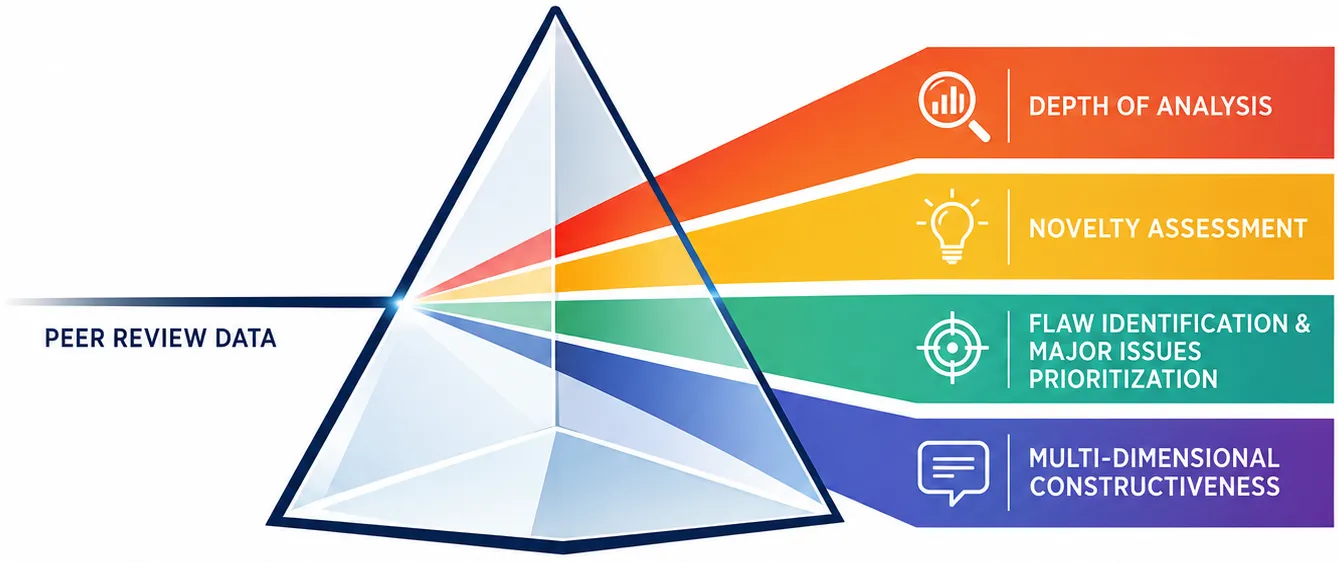
We introduce the PRISM Benchmark (Peer Review Intelligence via Structured Multi-dimensional assessment), a benchmark for evaluating both LLM-generated and human reviews across four core duties: depth of analysis, novelty assessment, flaw identification and prioritization, and multi-dimensional constructiveness. Each duty is measured through a dedicated pipeline grounded in argument mining, retrieval-augmented verification, and consensus-based scoring. Across 1,000 papers from ICLR, ICML, and NeurIPS, PRISM shows that LLM reviewers can be strong task-matched specialists, but no single system matches the balanced performance of human reviewers. LLM reviewers are therefore best used as deliberate, human-assisted supplements rather than general-purpose replacements.
Insights
- No single LLM reviewer is best at everything. Strong systems specialize in depth, novelty, flaw scanning, or constructiveness.
- LLMs are strong specialists, not full replacements for human reviewers. They excel at exhaustive scanning and systematic verification.
- The best workflow is human-led and LLM-assisted. Humans remain the most balanced and calibrated judges.
Introducing PRISM
Major ML venues now receive tens of thousands of submissions, which makes reviewer assignment, workload, and review quality increasingly difficult to manage. LLM reviewers offer scale, but common evaluation methods often rely on surface similarity metrics or broad LLM-as-a-judge scores. These approaches can blur together fluency, factuality, and scientific rigor.
PRISM asks a stricter question:
Does a review provide grounded analysis, calibrated novelty judgment, valid flaw detection, and actionable feedback?
To answer it, PRISM evaluates each manuscript-review pair through four independent and interpretable pipelines. Each pipeline extracts small review units, verifies them against the manuscript or prior literature, and computes metrics from those structured decisions instead of relying on a single opaque judge rating.

What PRISM Measures
| Dimension | What it checks | Metric output |
|---|---|---|
| Depth of Analysis | Whether reviews are detailed and grounded in manuscript or literature evidence | Premise Ratio, Grounding Score, DoA |
| Novelty Assessment | Whether novelty claims are supported by retrieved prior work | Novelty Score, Support Rate, Strict Support Rate |
| Flaw Identification | Whether reviews identify and prioritize critical vs. minor scientific issues | Critical Recall, Minor Recall, nCPS |
| Constructiveness | Whether feedback is actionable, specific, justified, solution-oriented, and professional | Mean Constructiveness Score |
PRISM uses constrained LLM judging for extraction and labeling. The final scores are computed analytically from structured labels, retrieval evidence, and consensus verification — not from a single opaque judge rating.
Methods
Results and Analysis
Across 1,000 papers from ICLR, ICML, and NeurIPS, PRISM shows that LLM reviewers tend to specialize in different review responsibilities. No single system dominates all four dimensions.
Headline Results
| Evaluation Dimension | Best Automated System | Human Baseline |
|---|---|---|
| Depth of Analysis | CycleReviewer: 0.484; DeepReview: 0.483 | 0.494 |
| Novelty Assessment | SEA: 0.833 | 0.787 |
| Critical Flaw Recall | Reviewer2: 0.591 | 0.343 |
| Minor Flaw Recall | Reviewer2: 0.459 | 0.281 |
| Prioritization | SEA: 0.977 | 0.973 |
| Constructiveness | DeepReview: 0.634 | 0.566 |
Key Findings
- Humans remain the most balanced baseline: Human DoA = 0.494, leading through premise density and methodology focus.
- DeepReview and CycleReviewer nearly match human depth: DoA = 0.483 and 0.484. Structured reasoning helps LLMs produce substantiated critiques.
- SEA has the strongest novelty grounding: Novelty score = 0.833 vs. human = 0.787. Retrieval-oriented pipelines verify literature claims.
- Reviewer2 is the best flaw scanner: Critical Recall = 0.591 vs. human = 0.343. LLMs surface missed issues for human reviewers.
- DeepReview gives the most constructive feedback: MCS = 0.634 vs. human = 0.566. It closes the loop from “this is a problem” to “here is how to fix it.”
Human and LLM reviewers are complementary. Humans excel at balanced judgment and calibration; LLMs excel at exhaustive scanning and systematic verification.
How to Use the PRISM Benchmark
Since no single system dominates all four dimensions, the evidence points toward targeted specialist use within a human-led pipeline.
| Need | Use |
|---|---|
| Find more critical flaws | Reviewer2 |
| Draft constructive feedback | DeepReview |
| Check novelty against literature | SEA |
| Make the final decision | Human reviewers |
These systems are most effective as specialist assistants within a human-led pipeline, not as autonomous reviewers.
Strengths and weaknesses by system
| System | Strength | Weakness |
|---|---|---|
| Reviewer2 | Exhaustive flaw scanning (highest recall) | Limited solution provision |
| DeepReview | Constructive feedback (actionable, professional) | Slightly lower flaw recall |
| SEA | Novelty verification (highest literature support) | Lower constructiveness |
| CycleReviewer | Strong analytical depth | High hallucination rate |
| TreeReview | Limited comparative advantage | Surface-level trap (24% effort on formatting) |
Related Systems
PRISM belongs to public benchmarks and reviewer-assistance projects that emphasize inspectable evaluation. Related systems include Reviewer2, SEA, DeepReview, TreeReview, and CycleReviewer.
BibTeX
@article{prism2026, title={PRISM: A Multi-Dimensional Benchmark for Evaluating LLM Peer Reviewers}, author={Ngoc Phan, Toan Huynh, Tran Khanh Thanh, Duy A. Nguyen, Nguyen Pham Tuan Anh, Thanh Nguyen, Nitesh V. Chawla, Wray Buntine, Kok-Seng Wong, Khoa D Doan, Binh Nguyen}, journal={arXiv preprint}, year={2026}}